There Can Be Only One
In my musical youth, my favorite radio segment was a nightly head-to-head battle of the bands called The Cage Match on Philly's now-defunct modern rock station, Y-100. The battle would pit two new, unheralded songs against each other. After playing both songs, the DJ would take votes from listeners before announcing the champion that would continue to the next night. If a champion carried on for two weeks, it would be retired into the Cage Match Hall of Fame and might get some decent airplay during the day.
But the thing I remember most fondly about the Cage Match was the sound clip they'd play to introduce it, "There can be only one." I never knew what it was from, but it sounded cool as hell.
Two months ago, I heard the clip in context for the first time ever when I watched Highlander, a movie whose mere existence is inexplicable. But more on that later. Today's assumption is a ridiculous one, but if it's true, I'm faithful that I've unlocked many secrets of the universe.
 When he says, "The Highlander was a documentary...and the events happened in real time," clearly he cannot be speaking literally. This is evident because the film itself does not take place in direct sequence, at times jumping from forward centuries at a time, or even jumping from nighttime to the next day's events. Thus, the movie could not have happened in real time. Since Shake's statement would be partly untrue literally, let's assume he is not speaking literally.
Now: Think of the statement figuratively. Highlander was a documentary, a film designed to capture a true-to-life story without scripting or staging. It has a message. If Highlander is a documentary on a figurative level, it's by definition not the same as, say, Bowling For Columbine. But what does that make it?
It could, theoretically, be a mockumentary. But it's not a funny movie, so that's probably not true. So what else is like a documentary but not a documentary?
Reality television.
Shake is saying that Highlander is on the same level of truth as The Real World, or Survivor, or The Apprentice. The story is framed in such a way that, with the use of a staged plot, heavy editing, and real-life average joes starring as themselves on TV, a very slightly fictionalized version of reality is portrayed.
Now, apply those qualities to Highlander. First of all, the plot was not historically accurate. Okay, I can accept that. Maybe they fudged some details. No biggie; we do that every Thanksgiving Day.
Second of all, the film stock was heavily edited. This is an easy concession, as life (unfortunately) does not come with a live soundtrack recorded by Queen. Sorry, but Freddie Mercury is dead.
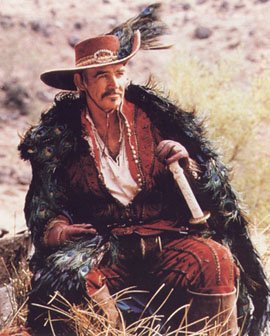
 Finally, since points one and two are clearly true, we move to a big one: Real-life average joes play themselves. Do you understand what this means? It means that Christopher Lambert wasn't just playing MacLeod. Christopher Lambert IS THE HIGHLANDER. Sean Connery was just making extra cash when he was playing James Bond, because he was actually an immortal, Egyptian-born Spanish warrior named Juan-Sanchez Villa-Lobos Ramirez, who fought with a Japanese blade and spoke with a Scottish accent. Why am I speaking in the past tense? Because Sean Connery is fucking dead. He was beheaded by The Kurgan. The Sean Connery who said "Losers always whine about their best; winners go home and fuck the prom queen" in The Rock and starred in The Hunt For Red October — he's an impostor, in the same way Paul McCartney died and was replaced back in the middle of Beatlemania.
More importantly, it is now clear that Christopher Lambert is a brutal serial killer who must be stopped. He can only be killed by decapitation, so this could be difficult.
Since we've established that Highlander was unscripted, heavily edited reality entertainment, its message doesn't necessarily have to be as clear as a typical documentary. But it does have to say something about society, as shows like The Hills and The Real World do in a more roundabout way. What is Highlander trying to tell us about ourselves?
The answer to that question could be left up to personal interpretation. But my interpretation is that Highlander's overarching conceit is revealed in the first scene featuring present-day NYC Christopher Lambert. He stands in a sold-out arena of fans shouting wildly, watching a pro wrestling match in the ring below. But The Highlander does not cheer. He watches in silence and leaves before the evening's matches are complete.
 The message, to me, is clear. The Highlander's world is a lifelong series of wrestling matches. He wins them, one by one, until he is the last man standing. There can be only one. The world's mortals find this life exciting from a distant view. But The Highlander does not enjoy this lifestyle. He is unhappy. He just wants it to be over. Why? There can be only one, the movie's mantra. Immortality is a lonely life, one mortals could never understand. Eternal life is not heaven. It's hell. You love someone, and the next thing you know they're being raped by The Kurgan after the decapitation of your mentor. They later die, and you only find out about it a thousand years later when The Kurgan lets it slip in a Roman Catholic church. I'll take mortality.
But we, the mortal society, do not understand. That's why Western religion is so popular. Perhaps Christopher Lambert hates God, because he knows better than to love some asshole who screws you into a life of eternal emotional anguish.
That's what Highlander tells us about ourselves. We ignorant mortals want eternal life, but we don't understand how painful eternal life can be. The Highlander understands.
The events didn't literally happen in real time, but metaphorically, Highlander takes the saga of an immortal tribal Scotsman (a Highlander, MacLeod) and over the span of two hours reveals through flashback how he became the greatest warrior in the history of the world. He kills The Kurgan in present day NYC to become the only immortal left. There can be only one.
Think about that. The movie lasts two hours in real time, but it encapsulates a worldwide epic tournament of champions that lasts over 600 years. Probably more.
 Symbolically, Highlander is saying something very bold about immortality: A) It doesn't exist for just anyone, as The Kurgan found out; B) It's dissatisfying, as MacLeod and Ramirez can attest; and most importantly, C) Human existence at its peak of glory can be portrayed in its entirety in a two-hour film.
Humanity is nothing compared to everything else out there. Sure, MacLeod has killed The Kurgan to win "the prize," but what if there are more immortals not of this earth? What if "the prize" is hell compared to what lies behind the decapitations of extraterrestrial immortals?
When Master Shake says Highlander's events happened in real time, what he's actually doing is making a statement on the insignificance of human existence.
Want a real mindfuck? Master Shake is a character on a TV show that was created, produced and distributed by humans. If humans are insignificant, Master Shake is even less significant because he is a slave of humanity. And thus, his metaphoric statement about Highlander should carry little to no significance whatsoever.
Or maybe, just maybe, for those reasons, it's the most significant thing anyone's ever said.
But the thing I remember most fondly about the Cage Match was the sound clip they'd play to introduce it, "There can be only one." I never knew what it was from, but it sounded cool as hell.
Two months ago, I heard the clip in context for the first time ever when I watched Highlander, a movie whose mere existence is inexplicable. But more on that later. Today's assumption is a ridiculous one, but if it's true, I'm faithful that I've unlocked many secrets of the universe.
*
For the sake of argument: Let's assume Master Shake, a character from Aqua Teen Hunger Force, is a credible one, that his statements are meant to be taken seriously. When he says, "The Highlander was a documentary...and the events happened in real time," clearly he cannot be speaking literally. This is evident because the film itself does not take place in direct sequence, at times jumping from forward centuries at a time, or even jumping from nighttime to the next day's events. Thus, the movie could not have happened in real time. Since Shake's statement would be partly untrue literally, let's assume he is not speaking literally.
Now: Think of the statement figuratively. Highlander was a documentary, a film designed to capture a true-to-life story without scripting or staging. It has a message. If Highlander is a documentary on a figurative level, it's by definition not the same as, say, Bowling For Columbine. But what does that make it?
It could, theoretically, be a mockumentary. But it's not a funny movie, so that's probably not true. So what else is like a documentary but not a documentary?
Reality television.
Shake is saying that Highlander is on the same level of truth as The Real World, or Survivor, or The Apprentice. The story is framed in such a way that, with the use of a staged plot, heavy editing, and real-life average joes starring as themselves on TV, a very slightly fictionalized version of reality is portrayed.
Now, apply those qualities to Highlander. First of all, the plot was not historically accurate. Okay, I can accept that. Maybe they fudged some details. No biggie; we do that every Thanksgiving Day.
Second of all, the film stock was heavily edited. This is an easy concession, as life (unfortunately) does not come with a live soundtrack recorded by Queen. Sorry, but Freddie Mercury is dead.
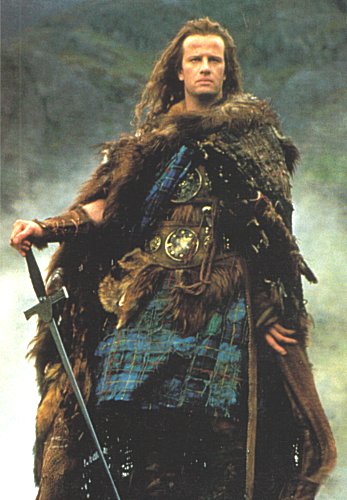 Finally, since points one and two are clearly true, we move to a big one: Real-life average joes play themselves. Do you understand what this means? It means that Christopher Lambert wasn't just playing MacLeod. Christopher Lambert IS THE HIGHLANDER. Sean Connery was just making extra cash when he was playing James Bond, because he was actually an immortal, Egyptian-born Spanish warrior named Juan-Sanchez Villa-Lobos Ramirez, who fought with a Japanese blade and spoke with a Scottish accent. Why am I speaking in the past tense? Because Sean Connery is fucking dead. He was beheaded by The Kurgan. The Sean Connery who said "Losers always whine about their best; winners go home and fuck the prom queen" in The Rock and starred in The Hunt For Red October — he's an impostor, in the same way Paul McCartney died and was replaced back in the middle of Beatlemania.
More importantly, it is now clear that Christopher Lambert is a brutal serial killer who must be stopped. He can only be killed by decapitation, so this could be difficult.
Since we've established that Highlander was unscripted, heavily edited reality entertainment, its message doesn't necessarily have to be as clear as a typical documentary. But it does have to say something about society, as shows like The Hills and The Real World do in a more roundabout way. What is Highlander trying to tell us about ourselves?
The answer to that question could be left up to personal interpretation. But my interpretation is that Highlander's overarching conceit is revealed in the first scene featuring present-day NYC Christopher Lambert. He stands in a sold-out arena of fans shouting wildly, watching a pro wrestling match in the ring below. But The Highlander does not cheer. He watches in silence and leaves before the evening's matches are complete.
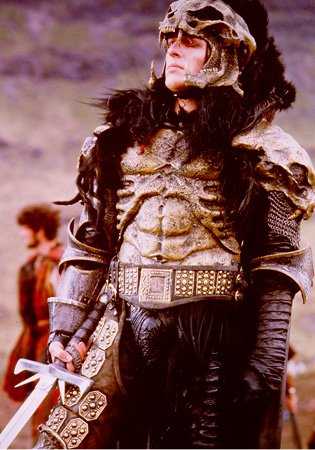 The message, to me, is clear. The Highlander's world is a lifelong series of wrestling matches. He wins them, one by one, until he is the last man standing. There can be only one. The world's mortals find this life exciting from a distant view. But The Highlander does not enjoy this lifestyle. He is unhappy. He just wants it to be over. Why? There can be only one, the movie's mantra. Immortality is a lonely life, one mortals could never understand. Eternal life is not heaven. It's hell. You love someone, and the next thing you know they're being raped by The Kurgan after the decapitation of your mentor. They later die, and you only find out about it a thousand years later when The Kurgan lets it slip in a Roman Catholic church. I'll take mortality.
But we, the mortal society, do not understand. That's why Western religion is so popular. Perhaps Christopher Lambert hates God, because he knows better than to love some asshole who screws you into a life of eternal emotional anguish.
That's what Highlander tells us about ourselves. We ignorant mortals want eternal life, but we don't understand how painful eternal life can be. The Highlander understands.
*
Now that we've looked at the first half of Master Shake's statement, we can look at the second part: "The events happened in real time."The events didn't literally happen in real time, but metaphorically, Highlander takes the saga of an immortal tribal Scotsman (a Highlander, MacLeod) and over the span of two hours reveals through flashback how he became the greatest warrior in the history of the world. He kills The Kurgan in present day NYC to become the only immortal left. There can be only one.
Think about that. The movie lasts two hours in real time, but it encapsulates a worldwide epic tournament of champions that lasts over 600 years. Probably more.
 Symbolically, Highlander is saying something very bold about immortality: A) It doesn't exist for just anyone, as The Kurgan found out; B) It's dissatisfying, as MacLeod and Ramirez can attest; and most importantly, C) Human existence at its peak of glory can be portrayed in its entirety in a two-hour film.
Humanity is nothing compared to everything else out there. Sure, MacLeod has killed The Kurgan to win "the prize," but what if there are more immortals not of this earth? What if "the prize" is hell compared to what lies behind the decapitations of extraterrestrial immortals?
When Master Shake says Highlander's events happened in real time, what he's actually doing is making a statement on the insignificance of human existence.
Want a real mindfuck? Master Shake is a character on a TV show that was created, produced and distributed by humans. If humans are insignificant, Master Shake is even less significant because he is a slave of humanity. And thus, his metaphoric statement about Highlander should carry little to no significance whatsoever.
Or maybe, just maybe, for those reasons, it's the most significant thing anyone's ever said.
posted by Kevin A. Doran at 12:24 PM


1 Comments:
what about highlander 2?
Post a Comment
<< Home